In northern Sweden, a quiet but powerful transformation is taking place. While global conversations revolve around the urgency of decarbonization, the municipality of Boden is proving that action can speak louder than words. Leading this ambitious shift is Bodenxt—a unique platform reshaping industry, society, and the environment simultaneously.
Unlike a conventional government department or corporate brand, Bodenxt is best described as a “transformation platform.” Conceived by Bodens Kommun, it is the strategic engine driving one of the most extensive industrial and social transformations in modern Europe. This article explores Bodenxt’s purpose, its five key pillars, and the profound implications for residents, businesses, and the global green energy movement.
Bodenxt: More Than Just a Name
The northern Swedish landscape is on the cusp of change. The establishment of Stegra (formerly H2 Green Steel) in the Boden Industrial Park signals an industrial leap equivalent to two decades of societal development—but compressed into just a few years.
Bodenxt emerged as the municipality’s answer to this rapid industrialization. Mats Berg, Head of Business Development in Boden, explains that the idea was born in early 2021 when officials realized that conventional municipal approaches “would not function” under such pressure. Bodenxt operates as a cross-sectoral development organization, running alongside traditional municipal structures.
Think of Bodenxt as a living greenhouse for ideas. It nurtures innovation—not only in steel production but across the ecosystem needed to support a rapidly growing population and industry. Its work spans four main “growth beds”: Skills Supply, Living & Housing, Business Development, and Infrastructure (both above and below ground).
The Industrial Anchor: Green Steel and Hydrogen
At the heart of Bodenxt’s mission is the 550-hectare Boden Industrial Park, where Stegra is constructing a large-scale green steel and hydrogen production facility. The figures are impressive:
-
Production Capacity: ~5 million tonnes of green steel annually.
-
Emissions Reduction: Up to 95% lower CO₂ compared to traditional blast furnaces.
-
Direct Jobs: Around 2,000 industrial jobs projected by 2030.
-
Economic Impact: Sweco estimates a contribution of 43 billion SEK to Sweden’s GDP and over 20 billion SEK in tax revenue by 2035.
Yet, Bodenxt knows that a factory alone isn’t enough. Building a plant for 2,000 workers without housing, schools, or support systems would be futile. This is where its five structural pillars come into play.
The Five Pillars of Bodenxt
To manage two decades of growth in just a few years, Bodenxt operates through five coordinated workstreams—ensuring social development keeps pace with industrial expansion.
1. Skills Supply (Kompetensförsörjning)
People are at the core of industry. Bodenxt collaborates with vocational institutes, universities, and local schools to secure the labor pipeline.
Example: The “Grundskoleutmaningen” (Primary School Challenge) encourages students as young as six to solve real-world problems, such as how to help new residents feel welcome—instilling entrepreneurial thinking from an early age.
2. Living & Housing (Leva och Bo)
Housing is one of the most urgent challenges. With thousands of workers arriving during the construction phase, Bodenxt has fast-tracked housing solutions.
Example: Temporary housing accommodates up to 132 residents, while projects like Slipvägen and Nylandsbäcken are being developed for 2,000–3,000 workers. Abandoned river valley houses (“ödehus”) are being transformed into modern, sustainable homes through initiatives like Visioner i Norr.
3. Business Development (Näringslivsutveckling)
Bodenxt ensures local SMEs benefit from the industrial boom. Rather than focusing solely on large corporations, it integrates local suppliers into the emerging green economy.
4. Infrastructure Above Ground
This pillar includes roads, railways, and energy grids. Notably, the railway to the industrial park was completed ahead of schedule and under budget—a rarity in European projects.
5. Infrastructure Below Ground
Critical yet often unseen systems—utilities, fiber networks, and subsurface planning—are coordinated with above-ground development to avoid costly rework.
A Parallel Transformation: Defense and Security
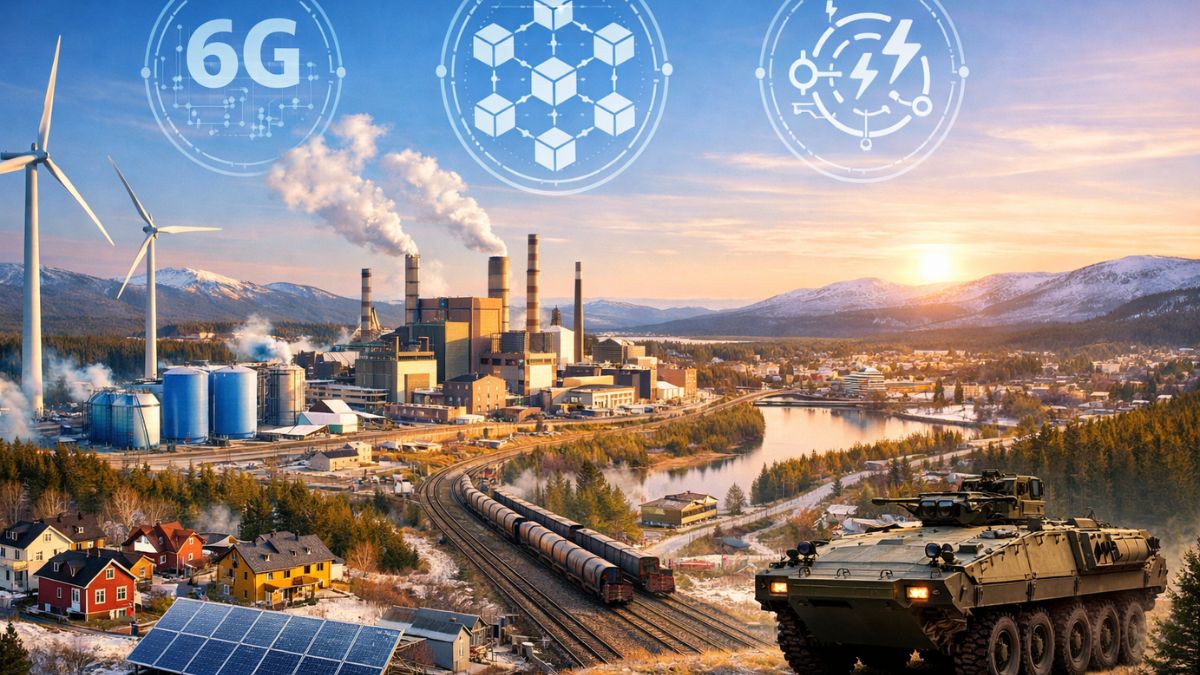
Boden is also a historic garrison town. Recognizing global security trends, Bodenxt has leveraged its position to integrate defense-related opportunities. Through “Bodenxt Talks,” local businesses are connected with Swedish Armed Forces procurement officers, opening avenues for supplying everything from construction materials to food services.
This dual focus on green industry and defense creates a resilient economy, capable of weathering sector-specific downturns.
Living Labs and Future Technologies
Bodenxt extends beyond steel and defense. The municipality is turning the region into a living lab for next-generation technologies, linked to the “Green Transition North” research cluster:
-
6G Networks for optimized mining and manufacturing processes.
-
Digital Product Passports leveraging blockchain to trace components and enable circular economy principles.
-
Smart Energy Systems to enhance grid flexibility for renewable energy integration.
-
Waste Heat Utilization, such as using server room heat to power greenhouses.
Overcoming Challenges
Rapid transformation brings challenges. The influx of workers has sparked housing speculation, with private homes being rented out at high rates, potentially destabilizing local markets. Mats Berg criticizes such practices as creating “risky living structures.”
Crime prevention, worker safety, and public transparency remain ongoing priorities. A recent controversy over a Sweco report—detailing economic benefits of the Stegra plant—highlighted tensions between corporate confidentiality and public access, reflecting the delicate balance between rapid industrialization and societal accountability.
Conclusion: A Model for the Future
Bodenxt demonstrates how a small municipality can lead a green industrial revolution. By aligning industrial growth with social infrastructure, engaging young citizens in planning, and supporting local businesses in energy and defense sectors, Boden is ensuring that growth benefits the entire community.
As the world watches the heavy industry decarbonization experiment in Boden, success here could provide a blueprint for sustainable prosperity—showing that the green transition can be both an environmental necessity and a driver of inclusive economic development.