Sword for a Pirate NYT, We gamers live in a world of specialized vocabulary. We talk about DPS checks, aggro ranges, perfect parries, and spawn camping. This lingo is our secret handshake, a wall of jargon that can seem impenetrable to outsiders. But sometimes, the wider world gets a glimpse—and the resulting collision can be both baffling and beautiful. This is exactly what happened in the spring of 2023, when a simple, five-letter clue in The New York Times crossword brought the vast, interconnected realms of gaming culture crashing into the quiet, pencil-scratching world of puzzle enthusiasts.
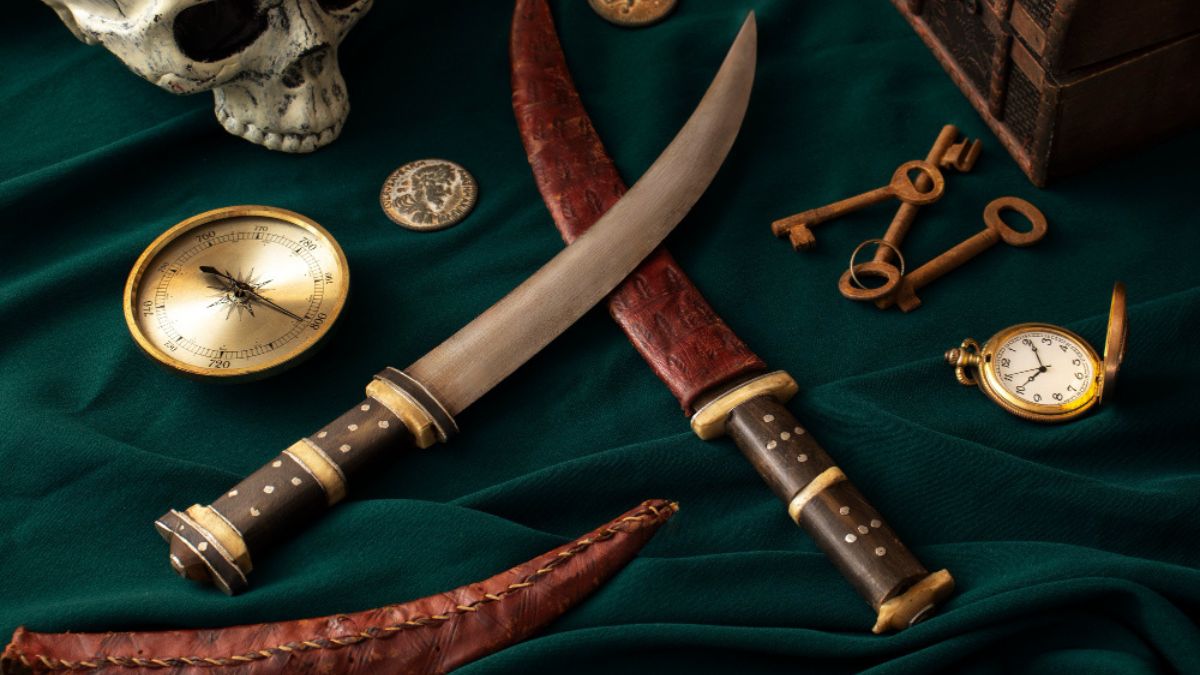
The clue was “Sword for a Pirate NYT.”
The answer, to the consternation of probably millions of non-gamers, was CUTLASS.
If you’re reading this and thinking, “Well, duh,” you’re one of us. You’ve sailed the virtual seas of Assassin’s Creed IV: Black Flag, plundered outposts in Sea of Thieves, or meticulously managed resources in Sid Meier’s Pirates!. The cutlass isn’t just *a* pirate sword; in the modern lexicon, it is the pirate sword. But for the traditional crossword solver? The one whose mental rolodex flips to classic literature, historical fact, and perhaps Errol Flynn movies? They might have been scratching their heads, thinking of sabers, rapiers, or the more generic “blade.”
This wasn’t just a clue. It was a cultural reveal. It showed how gaming hasn’t just created its own universe; it has begun to rewrite the shared dictionary of our collective imagination.
From Rigid Steel to Polygonal Pixels: The Evolution of a Weapon
Let’s talk about the cutlass itself, historically. It was a short, broad sabre with a slightly curved blade, ideal for the close-quarters chaos of boarding a ship. It was a tool of utility and brutality, less finesse than sheer force. You’d find it in history books, in museum cases, its steel often pitted with age and salt.
Now, close your eyes and picture a cutlass. I’d wager the image that forms isn’t from a museum. It’s likely digital. It might be the glint of the sun on Edward Kenway’s blade as he perches on a masthead in Black Flag. It could be the cartoonish, slightly goofy yet deadly arc of your pirate’s swing in Sea of Thieves, accompanied by that satisfying shink-thud. Perhaps it’s the pixelated icon you’d select in The Legend of Zelda: The Wind Waker.
Gaming didn’t invent the cutlass’s association with pirates, but it cemented it, amplified it, and made it visceral. In a movie, you watch a pirate fight. In a game, you are the pirate. You feel the heft of the virtual cutlass (through controller rumble or the deliberate swing animation). You learn its timing, its range, its damage output. You don’t just know what a cutlass is; you have muscle memory for it. This embodied knowledge is profound. It moves a word from the realm of “fact I know” to “tool I have used.”
For the NYT crossword—a publication that prides itself on being a chronicle of the contemporary literate mind—to use this clue was a quiet, monumental acknowledgment. It said: “The cultural touchstones of a massive, global community are now our touchstones. The knowledge forged in virtual taverns and on digital waves is valid, widespread, and crossword-worthy.”
The Ripple Effect: When Subcultures Speak the Same Language
The aftermath online was a delightful study in subcultural collision. Twitter (now X) and Reddit lit up.
On one side, you had the crossword enthusiasts, often older and from a different media consumption background. The comments were a symphony of bemused acceptance: “Well, I learned something new today!”; “Had to call my grandson for this one—he laughed at me for ten minutes.”; “I kept thinking ‘saber,’ but that didn’t fit. The world has passed me by!”
On the other side, gamers were having a collective, gleeful meltdown. In forums and discords, the posts were triumphant: “THEY ACKNOWLEDGE US!”; “My years of plundering virtual grog finally paid off!”; “I solved an Sword for a Pirate NYT clue in under a second because I’ve sunk 500 hours into Sea of Thieves. What timeline is this?”
For gamers, especially those of us who grew up being told our hobby was a waste of time, this was a moment of vindication. It wasn’t about being “smart” in a traditional sense; it was about our very specific, hard-earned, fun-acquired knowledge being validated by one of the most prestigious intellectual puzzles in the world. Our “wasted time” had just filled in 5-Down.
This moment highlighted a beautiful democratization of knowledge. You don’t need a degree in naval history to know what a cutlass is anymore. You might just need a Xbox Game Pass subscription and a few friends to crew a galleon. The paths to being “culturally literate” are multiplying, and gaming is a superhighway.
More Than a Sword for a Pirate NYT: Gaming’ Lexicon Conquers All
“Sword for a pirate” is just the tip of the iceberg. Gaming language is seeping everywhere. Consider:
-
Elden Ring and “Touch Grace”: FromSoftware’s masterpiece made the phrase “Touch Grace” (to activate a Site of Grace checkpoint) a meme beyond gaming. It’s now used metaphorically online for taking a break, finding peace, or saving your progress in real life.
-
The “Resident Evil” Inventory Tetris: The stress of managing a limited, grid-based inventory is so iconic that it’s become shorthand for packing a suitcase, organizing a closet, or any logistical puzzle.
-
“NPC” as a Social Label: Once strictly a gaming term for Non-Player Character, it’s now a (often derogatory) slang for someone who seems to lack independent thought or agency in social situations—a fascinating and controversial linguistic migration.
-
“Lag” and “IRL”: These are so embedded we forget their roots. Complaining about “real-life lag” when you’re tired is a universally understood concept.
The NYT has used other gaming clues before—“Mario’s love” for PEACH, “Legendary video game plumber” for MARIO—but these felt like nods to iconic figures. “Sword for a pirate” was different. It wasn’t about a character; it was about a specific item whose primary modern association is interactive. It tested not pop culture recognition, but genre literacy.
The Human Connection: Why This Moment Mattered
Beyond the linguistics, this story is human. It’s about a grandfather, stumped by his morning ritual, calling his distant grandson. For once, the knowledge flow reversed. The kid wasn’t being taught; he was the teacher. Their conversation likely spiraled out from that one answer. “What game is it from, grandpa? Oh, well, there’s this game where you sail a ship and there’s this kraken and you have to play shanties…” A bridge was built, not out of obligation, but out of shared curiosity sparked by a crossword puzzle.
It’s about the puzzle editor, maybe not a hardcore gamer themselves, recognizing that a clue needed to reflect where our collective mind now lives. Part of it is in books, part in films, and a massive, vibrant part is in interactive worlds.
For us, the gamers, it was a reminder that our passion isn’t isolating. The skills we hone, the stories we internalize, the worlds we navigate—they are building a shared mythology. When you describe the eerie beauty of the Glowing Sea in Fallout 4, the heart-pounding tension of a Counter-Strike round, or the melancholic vastness of Shadow of the Colossus, you’re not just talking about code and graphics. You’re talking about experience. You’re talking about art.
Sailing Forward: The Shared Sea of Stories, Sword for a Pirate NYT
So, the next time you pick up a controller, mouse, or mobile device, know this: you’re not just playing. You’re learning a new dialect of the human experience. You’re adding to a living, breathing culture that is now so influential it helps people complete their morning crossword over coffee.
The “sword for a pirate” clue was a tiny event in the grand scheme. But like a single, clear note from a sea shanty carried on the wind, it signaled something larger. The walls between “gamer” and “non-gamer,” between “high culture” and “pop culture,” between “useful knowledge” and “game trivia,” are crumbling. We are all, in a way, sailing the same sea now. Some of us have fancier ships, some are still on the dock wondering how to get aboard, but the water connects us all.
And on that sea, when someone shouts, “What’s a pirate’s sword?”, a chorus of voices—from seasoned captains who’ve battled krakens to new deckhands just finding their sea legs—will shout back, with confidence and a hint of pride, “A CUTLASS!”
That’s more than an answer. It’s a sign that we’re all speaking the same language, finally. And that is a treasure worth more than any virtual gold.